
AED Voice Prompts Explained: A Las Vegas Bystander’s Guide
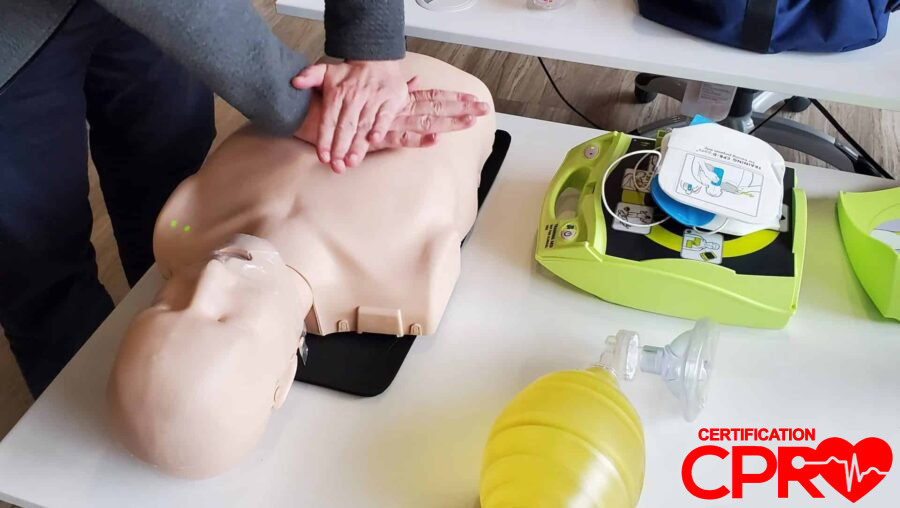
The voice that comes out of an AED is doing one specific job: keeping a stressful, messy scene moving in the right direction. A guest collapses on a Strip resort casino floor. A coworker drops in a Henderson conference room. The bystanders standing closest are about to run a rescue with no warning, and the device on the wall has been engineered so the script does not have to live in their heads. The prompts spell out what to do, in what order, with a small window after each instruction to act before the next one arrives.
Walking through each prompt before the day it matters is most of the way to making the audio feel familiar instead of foreign. The sections below cover the prompts a public AED actually says, what each one means, and what the rescuer’s hands should be doing at the same time. For the part that no article can deliver — repetition with an instructor watching — the AHA BLS CPR class in Las Vegas runs the full sequence on a manikin and an AED trainer.
What Happens When You Turn an AED On
Most public AEDs power on the moment the lid opens; some require a single press of a clearly marked green button. Either way, the device is talking within a second. The first prompts orient the rescuer to the response that has to be running in parallel: a reminder to call 911 if no one has, then an instruction to attach the electrode pads to the patient’s bare chest.
The voice is calm, slow, and built for someone hearing it for the first time. Some units add visual cues on a small screen, but the audio carries the sequence. Each prompt is meant to be followed before the next plays. Standing still to listen to the entire instruction wastes the window the device built into the cadence.
Upcoming CPR Class Dates and Times
Pad Placement Instructions
The pad-placement prompt is, the first long instruction the device gives: “attach pads to patient’s bare chest,” followed by a description of where each pad goes. Diagrams printed on the pads themselves repeat the same picture. One pad sits on the upper right chest just below the collarbone. The other goes on the lower left side a few inches below the armpit.
Some models add “plug in connector,” meaning the cable that links the pads to the device needs to be inserted. Newer units come with the cable pre-connected, which makes the prompt feel like it is asking for nothing. If you hear it and see no loose cable, the pads are already wired in through the case.
Pad obstacles are common and fast to fix. Heavy chest hair gets a few passes from the kit’s razor or the “peel-and-pull” trick with the first set of pads. A wet chest gets toweled. A visible pacemaker bulge under the upper chest skin is reason to slide the pad an inch or two clear of the implant, not reason to stop the rescue.
Analyzing Rhythm
Once the pads are seated and connected, the device announces “analyzing heart rhythm” or “do not touch patient.” That prompt has a hard meaning: every hand comes off the body. Compressions stop. The rescuer at the head pulls back. Anyone leaning in to comfort or to look closer steps clear.
The AED is reading the heart’s electrical activity for a few seconds and any contact pollutes the trace. The pause feels longer than it actually is, especially under stress, but interrupting the analysis sends the device back to the start of the cycle. Stay clear, hold the room still, and wait for the next prompt.
Shock Advised vs No Shock Advised
The analysis ends with one of two announcements. “Shock advised” means the device has detected ventricular fibrillation or pulseless ventricular tachycardia — a rhythm defibrillation may correct — and the AED begins charging immediately. “No shock advised” means the rhythm currently visible is not one electricity can fix.
The temptation with “no shock advised” is to read it as good news. It is not. Asystole and pulseless electrical activity both produce that result, and both are still cardiac arrest. The right response to either announcement is the same in practice: keep the rescue moving on the device’s next instruction, which will route to compressions or to a shock-then-compressions cycle.
If a shock is advised, the device finishes charging —, a few seconds of audible whine — and announces it is ready to deliver. That is the cue to clear the patient one more time before the button press.
Stand Clear
“Stand clear” or “do not touch patient” precedes shock delivery on every public AED. The flashing button comes alive, and the rescuer’s last task before pressing it is the visual scan: every body around the patient out of contact, no hand on the shoulder, no knee pressed against the legs.
Saying it out loud helps. “Everyone clear” cuts through the noise of a CCSD school cafeteria, a crowded Las Vegas Convention Center hall, or a gym floor in Summerlin. Press the shock button only after the room is visibly clear. The shock itself is over in a fraction of a second, and the device immediately announces what comes next.
Resume CPR
“Begin CPR” or “start compressions” follows every shock and every “no shock advised” announcement. Compressions go back on the chest the second the prompt plays. The shock alone does not restart the heart; it interrupts a chaotic rhythm so the heart’s own pacemaker has a chance to retake the cadence, and that retake is far more likely if circulation is being maintained at the same time.
The device keeps running a clock. About two minutes into the compression cycle, it prompts another rhythm analysis: stop, clear, let the AED read again, respond to the next call. The loop continues until EMS from Clark County Fire or AMR takes over or the patient shows clear, unmistakable signs of return.
Compressions Prompts
Many newer AEDs include a CPR feedback feature that listens to the compressions through a sensor in the pads or a small puck on the chest. They speak in real time. “Push harder” means depth is short of the two-inch target on an adult chest. “Good compressions” means depth and rate are where they need to be. “Compress at a rate of 100 to 120” flags cadence, not depth.
The feedback is a calibration tool, not a critique. Adrenaline and fatigue both pull compressions away from the target depth and rate within the first minute or two; the device’s job is to nudge the rescuer back. When the prompt says push harder, the answer is to lean more weight into the chest until the prompt resolves.
Battery and Device Maintenance Prompts
An AED in its cabinet sometimes chirps or speaks during a routine self-check. “Replace battery,” “service required,” or a series of beeps from the device on the wall are maintenance alerts, not emergency announcements. The unit is asking the program manager to address something — battery life, expired pads, an internal fault — before the device is needed.
Workplace AED programs across the Las Vegas Valley — from CCSD school offices to Strip resort security operations to Henderson medical clinics — should have a written check schedule that catches those alerts in routine inspection. The AED that announces a service issue mid-rescue is the AED that did not get inspected in time.
What Voice Prompts Do Not Tell You
Upcoming CPR Class Dates and Times
The device’s voice runs the device’s sequence. It does not run the room. The 911 call belongs to the rescuer or to a designated bystander; the prompt mentions it, but the AED cannot dial. Crowd control, scene management, the decision to send a second person to the cabinet while compressions begin — all of that is human work. So is the recognition step that happens before the AED is opened: catching the collapse, checking responsiveness, confirming abnormal breathing.
That gap is exactly what training fills. A rescuer who has run through the full CPR-and-AED sequence in a class knows what to do in the seconds before the device starts speaking and how to keep the room functional through the parts the audio does not narrate. The AED handles its half. Training handles the rest.