
Where to Place an AED at Work: A Las Vegas Employer’s Guide
Buying an AED is the easy part. Where the cabinet ends up bolted to the wall is what determines whether the device ever does the job it was bought for. A Strip resort with units stationed at every elevator bank runs a meaningfully different rescue than a Henderson office park whose single AED sits behind a locked HR door. From the moment a person collapses, every second of retrieval matters; placement decides whether the device reaches the chest in time to be useful.
Most workplace safety standards target three to five minutes from collapse to defibrillation, and that target is not arbitrary. The brain begins to suffer irreversible damage without circulation almost immediately, and the data on shockable rhythms confirms it: every minute without defibrillation cuts survival probability by roughly ten percent. A device that takes four and a half minutes to retrieve is offering meaningfully less protection than one that takes ninety seconds, even though both are technically “in the building.”
Hitting that target inside a real Las Vegas Valley facility — a Strip resort tower, a CCSD school, a Summerlin office complex, a Henderson medical building, a North Las Vegas warehouse — means thinking about the building itself, not just the square footage on the lease. Floor count, security doors, elevator wait times, and where employees actually spend their time all shape how placement should be planned.
The Three-to-Five Minute Rule
The three-to-five minute rule measures the round trip: bystander to cabinet, cabinet open, device back to the patient. Distance in feet is the wrong unit. A two-hundred-foot walk down a clear corridor at MountainView Hospital’s administrative wing is a different retrieval than a two-hundred-foot path through a Strip resort back-of-house that crosses two card-keyed doors and an elevator hold.
Upcoming CPR Class Dates and Times
The most useful test is the walk-through. Pick the points furthest from each AED — the loading dock, the far conference room, the back warehouse aisle — and time the round trip at a normal pace. Anything over three to five minutes is a coverage gap, and a coverage gap calls for either an additional unit or a satellite cabinet closer to where people actually work.
Multi-story buildings almost always need one AED per floor. Asking a rescuer to ride an elevator down two floors mid-emergency adds a variable nobody can predict; stairwells are worse, especially in the older office stock around Sahara Avenue and Paradise Road where stairwell access doors sometimes lock from the floor side. Floor-level placement removes that variable entirely.
High-Traffic and High-Risk Areas
Cardiac arrest does not honor a schedule, but the events that get caught early happen where people are. Placing units near high-traffic zones increases the odds that the collapse is witnessed at all and that the device retrieval happens fast enough to matter.
Strong primary placements include conference rooms, lobbies, break rooms, fitness areas, and main corridors. Strip resort hotels concentrate AEDs at front-of-house security stations, ballroom backstage corridors, and pool deck supervisor offices for that exact reason. CCSD school deployments cluster around main offices, gym entries, and cafeterias. The principle is the same across industries: stage the device where the witnesses already are.
Physical exertion areas earn extra units. A workplace gym, a Las Vegas Convention Center loading dock, a hotel housekeeping prep floor, a hospitality kitchen line during a banquet rush — any space where employees are working at sustained physical effort raises baseline risk. Adding a dedicated unit nearby costs the price of the device and pads. Trying to retrieve from a corridor cabinet two hundred feet away costs response time the patient does not have.
Visibility and Signage
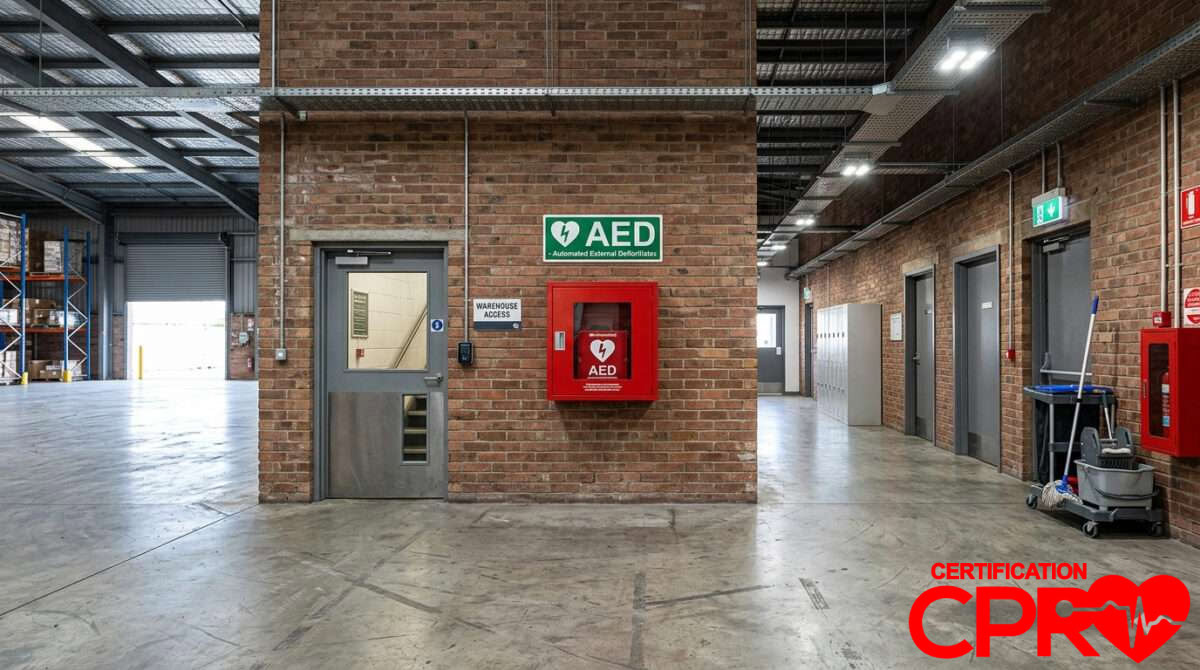
An AED nobody can find under stress is functionally absent. The cabinet has to be visible, clearly marked with the green-and-white AED sign, and located somewhere a guest or new employee can identify without asking for directions.
Wall-mounted cabinets at eye level with overhead signage are the standard. The cabinet should not be tucked into a corner alcove, hidden behind a planter, or staged below a desk. In larger spaces — Las Vegas Convention Center halls, casino floors, Allegiant Stadium concourses — projecting flag-mount signs that hang perpendicular to the wall help bystanders find the unit from across the room.
Cabinet alarms serve two functions at once. They alert nearby staff that a rescue is starting before anyone has had a chance to call out, and they discourage casual tampering. Some facilities resist alarm-equipped cabinets because of false-activation concerns; the alert function is part of what keeps the AED accessible to a frightened bystander who has never opened one before. The trade is worth it.
Avoiding Poor Placement Choices
Locked rooms, supply closets, nurse’s offices, and staffed-only spaces look secure on a facilities diagram. They are time sinks during a real rescue. A device that requires a key, a code, or a specific staff member adds retrieval time the patient cannot afford, and the rescuer who has to leave the patient to fetch credentials is the rescuer who arrives back too late.
Storage areas, loading docks, and maintenance spaces fail as primary placements unless those zones have their own resident workforce. Convenience for facilities staff is not a substitute for proximity to the people who actually fill the building.
Temperature is its own constraint, especially in the Las Vegas climate. A cabinet bolted to an exterior wall in direct summer sun, an unconditioned mechanical room in July, or a parking-garage corridor that bakes through a Mojave afternoon all expose the unit to conditions outside the manufacturer’s specification. Pad adhesive degrades, battery life shortens, and the next inspection finds a flagged device. Conditioned indoor space is the right answer.
Documenting and Communicating Locations
Every employee who works in the building should know where the AEDs are before there is any reason to need one. Building maps near elevators and entrances, AED location callouts in new-hire orientation, and coverage in emergency response planning all reinforce the same recall. The day the cabinet matters is not the day to start asking questions about which corridor.
Larger facilities sometimes integrate AED locations with building emergency systems or with smartphone apps that direct callers to the nearest unit. For sprawling employers — Strip resorts with thousands of rooms across multiple towers, the Las Vegas Convention Center campus, university buildings at UNLV — that integration meaningfully shortens retrieval time when the bystander does not know the property.
Knowing where the cabinet is matters less than knowing what to do once it opens. AED placement planning works best paired with onsite CPR and AED training, which puts the device in the hands of the people who will actually be standing closest when somebody drops.
Maintenance and Inspection Requirements
An AED that has not been inspected on schedule may not be ready when the cabinet opens. Pads expire. Batteries discharge. Firmware updates ship from the manufacturer. Every unit has a status indicator —, a small light or screen icon — that signals readiness, and a monthly visual check of that indicator is the floor most programs aim for.
Upcoming CPR Class Dates and Times
Assign each unit to a named owner. Document every inspection. Order replacement pads and batteries before the existing ones expire, not after, and keep a backup pad set in or near the cabinet so a used unit can return to service the same day. Training drills are also a quiet way to verify the cabinet path is still clear and the indicator still green.
After any actual use, the device has to be reset to ready status before going back into service. The manufacturer or maintenance vendor handles the reset, replaces used pads, and confirms the unit is operational. A device that fired in a real rescue is not automatically ready for the next one.